Celtic
Why Kasper Høgh’s goal was ruled out by John Beaton against Kilmarnock

Celtic VAR controversy deepens as Kasper Høgh decision raises questions over consistency
Kasper Høgh thought he had finally ended his frustrating wait for a Celtic goal when he found the net against Kilmarnock.
The Danish striker briefly celebrated what appeared to be an important moment in his Celtic career, but his excitement was short-lived after VAR intervened.
Høgh had finished off an impressive attacking move in the first half, only for referee John Beaton to be called over to the pitchside monitor to examine an earlier challenge involving Mika Baur and Kilmarnock’s Greg Kiltie.
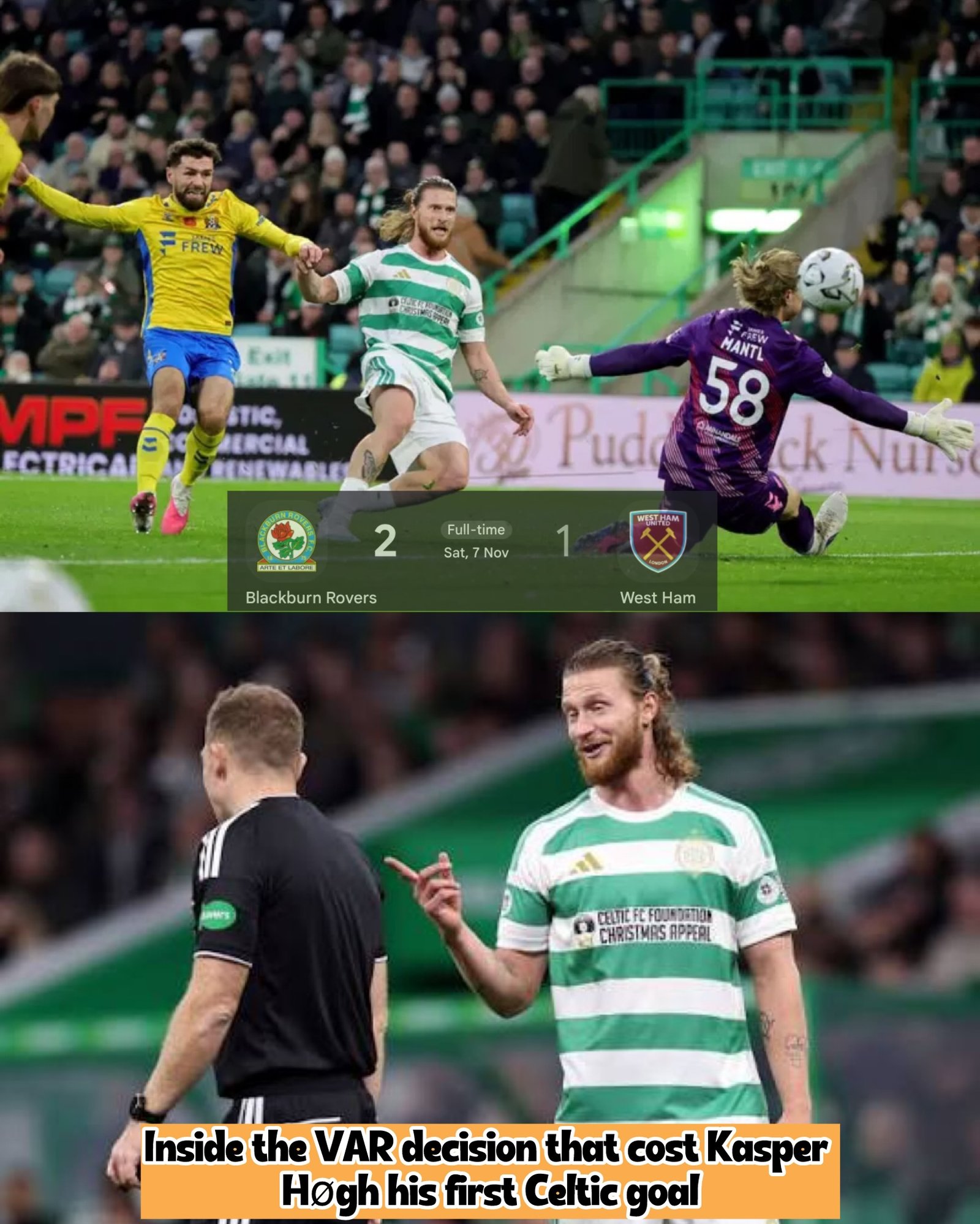
Beaton had initially allowed the game to continue before awarding Celtic the goal. However, after watching the footage, he reversed his decision and awarded the visitors a free-kick.
It was a decision that left plenty of room for debate.
Baur had made contact with Kiltie before Celtic recovered possession and launched the attack that eventually ended with Høgh scoring from close range.
There is little doubt that VAR was entitled to examine the incident. Under the protocol, an attacking-phase offence leading up to a goal can be reviewed.
However, the crucial requirement is that the referee’s original decision must have involved a clear and obvious error or a serious missed incident before it can be overturned.
That is precisely why Beaton’s intervention has attracted criticism.
There was contact between Baur and Kiltie, and opinions can reasonably differ over whether the challenge deserved a foul. However, questioning whether a foul could have been awarded is not the same as establishing that the referee made an obvious mistake by allowing play to continue.
The situation becomes even more interesting when compared with an incident from Rangers’ match against St Mirren on Saturday.
Rangers were awarded a penalty after James Penrice went down following contact with Samuel Ramos. Referee Nick Walsh immediately pointed to the spot, and VAR subsequently checked the decision without recommending an on-field review.
Replays appeared to show minimal contact, with St Mirren also expressing their dissatisfaction. Former Scotland international James McFadden described the penalty decision as ‘softer than soft’.
Despite the debate surrounding the incident, the original penalty decision was allowed to stand.
That creates an uncomfortable comparison between two decisions involving marginal contact in consecutive matches.
In Paisley, VAR did not consider the referee’s penalty award sufficiently incorrect to warrant an intervention.
At Celtic Park, however, the officials decided that Baur’s challenge on Kiltie justified sending Beaton to the monitor and subsequently cancelling Høgh’s goal.
The two incidents were different, and VAR decisions should always be judged on their individual circumstances. Nevertheless, the contrasting outcomes raise legitimate questions about how consistently the intervention threshold is being applied.
VAR was introduced to help correct significant refereeing mistakes, not to revisit every contentious challenge or turn marginal contact into a lengthy debate.
That distinction is particularly important when a goal is being reviewed.
For Høgh, the decision was especially frustrating. The striker had gone 15 Celtic appearances without scoring and appeared to have finally broken that unwanted run against Kilmarnock.
His celebration was cut short, leaving him to continue searching for his first goal in a Celtic shirt.
He was presented with another promising opportunity shortly afterwards but could not get past Kilmarnock goalkeeper Nico Mantl.
Martin O’Neill was reluctant to criticise the officials after the match, explaining that he had not been able to properly examine the incident on the small pitchside screen.
Speaking about the decision, the Celtic manager said the players had described it as a ‘touch and go’ situation.
He explained:
‘I have genuinely not seen it back because the little screen that we have is too small for me to see it, the wee one that we have down in the touchline.
‘So the minute they’ve not given it, I can only go by what the lads were saying. They thought it was touch and go.
‘I genuinely have not seen it back.’
That description raises an important question about the decision to intervene.
If the incident was considered marginal, what made it sufficiently clear and obvious for VAR to recommend that Beaton overturn his original call?
Celtic eventually secured all three points thanks to Liam Scales’ first-half strike, meaning the disallowed goal did not ultimately affect the result.
However, that does not remove the need to examine the decision.
The contrast with Rangers’ penalty against St Mirren makes the debate even more significant. Supporters are entitled to expect the same VAR principles to be applied consistently, particularly when decisions have such a major impact on matches.
Referees will inevitably have different interpretations of certain challenges, but VAR’s intervention threshold should not appear to change from one game to another.
Ultimately, the biggest question coming out of Celtic’s victory is not simply whether Baur fouled Kiltie.
It is

 Celtic2 months ago
McInnes reveals what sparked fiery touchline spat with Mark Fotheringham
- Rangers1 month ago
How Uefa Decision made Rangers Humiliation worse.
- Rangers1 month ago
Rangers star Bojan Miovski handed reality check after latest North Macedonia outing
- Rangers2 months ago
Tom English reacts to ‘dismal’ Rangers news as Ibrox concern emerges
- EFL2 months ago
EFL respond to Millwall request over David Sullivan ahead of West Ham clash
- Rangers1 month ago
Oli McBurnie may be feeling the heat as Scotland fans turn their Rangers frustration on him
- Celtic2 months ago
Derek McInnes involved in heated Celtic-Rangers exchange with John Fotheringham
- Celtic1 month ago
Celtic have already found McGregor replacement as Scott Brown backs star