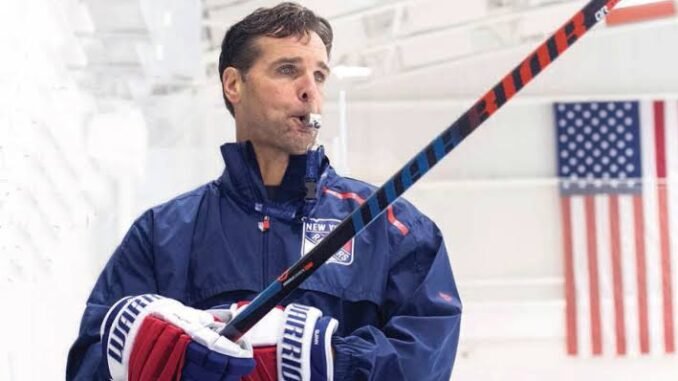
David Quinn: A Coach Built for the Modern NHL…read more…
David Quinn’s coaching journey has been defined by adaptability, resilience, and a deep understanding of what it takes to nurture talent in today’s ever-evolving NHL. With a career that spans collegiate hockey, the American Hockey League, and two stints with the New York Rangers, Quinn has earned a reputation as a player-first coach with a modern, developmental mindset. His recent return to the Rangers in 2025, now as an assistant under newly appointed head coach Mike Sullivan, marks both a homecoming and a renewed opportunity to influence a roster teeming with young talent.
Early Coaching Roots and Philosophy
David Quinn’s coaching career began after a promising playing career was cut short due to health issues. A first-round pick of the Minnesota North Stars in 1984, Quinn was forced to retire due to a diagnosis of Hemophilia B. But where his playing path ended, coaching began to take shape. Quinn transitioned into scouting and then coaching, quickly making a name for himself as someone who could connect with players at a personal level while also holding them accountable.
He spent significant time at Boston University (BU), first as an assistant coach and later as the head coach from 2013 to 2018. During his tenure at BU, Quinn led the team to four NCAA tournament appearances and developed future NHL stars such as Jack Eichel, Charlie McAvoy, and Clayton Keller. His ability to develop raw, youthful talent and mold it into elite performance was a hallmark of his college years—a strength that would follow him to the professional ranks.
First Stint with the New York Rangers (2018–2021)
Quinn took over the head coaching job for the Rangers in 2018, tasked with shepherding a team that was undergoing a full rebuild. It was a unique challenge for a first-time NHL head coach, especially in a media-heavy and results-driven market like New York. Nevertheless, Quinn leaned into his development strengths, helping transition prospects like Adam Fox, Igor Shesterkin, and K’Andre Miller into full-time NHL players.
His coaching style emphasized structure and effort but allowed room for creativity. He wasn’t a disciplinarian in the traditional sense—players responded to his open-door policy and his calm, communicative approach. That said, he faced criticism for line shuffling and being overly reactive in in-game decisions. The team never made the playoffs in his three full seasons, and in 2021, the Rangers opted for a change in direction, bringing in veteran coach Gerard Gallant.
A Detour and Growth with Team USA and San Jose
After leaving the Rangers, Quinn remained active in the hockey world, taking the helm of Team USA’s men’s national team for the 2022 Winter Olympics and World Championships. His leadership was praised, especially considering the tight turnaround and limited preparation time those tournaments often require. He emphasized teamwork, speed, and conditioning—elements that resonated with younger international rosters.
In 2022, Quinn was named head coach of the San Jose Sharks, inheriting another rebuilding team. Although the Sharks struggled in terms of wins and losses, the front office acknowledged his impact in laying a foundational culture and developing young players like William Eklund and Thomas Bordeleau. However, in 2024, the Sharks opted not to renew his contract, citing the need for a “new voice” during their rebuild.
Return to Broadway: Reunion with the Rangers (2025)
In 2025, with Mike Sullivan named head coach of the New York Rangers, Quinn’s return as an assistant coach surprised some but made strategic sense. The Rangers, once again leaning into a development-heavy strategy with prospects like Gabriel Perreault, Brennan Othmann, and Zac Jones, needed experience behind the bench that could support young players without overshadowing the new head coach’s authority.
Mike Sullivan and Quinn share similar hockey philosophies—emphasizing structure, puck support, and a quick transition game. Sullivan’s championship pedigree balances perfectly with Quinn’s development background, making the duo a compelling leadership core. The hiring also offers Quinn a chance to reset within a familiar environment, free from the intense scrutiny of a head coaching role.
Looking Ahead
David Quinn’s second chapter with the Rangers might not come with the spotlight of being the head coach, but it could prove just as meaningful. His value lies in the intangible—how he guides young players through adversity, how he communicates between coaching tiers and the locker room, and how he leverages past successes and failures to drive future wins.
In a league where coaching turnover is rapid and development windows are short, Quinn represents a rare combination: experience, patience, and the ability to teach. With the Rangers aiming to merge elite talent with long-term competitiveness, having David Quinn back behind the bench might be one of their smartest moves yet.
Leave a Reply