Because Jackie Robinson wore it throughout his historic baseball career with the Brooklyn Dodgers, the number 42 has unique meaning in the sports world.
However, Major Ogilvie or Eddie Lacy is likely the one represented by the number at Alabama.
Your age is likely to play a larger role in determining which one you relate to the most. During the 1977–1980 wishbone era, Ogilvie was a star for Paul “Bear” Bryant’s Crimson Tide.
He is the only Alabama football player to ever score a touchdown in four straight bowl games, and he won two national championships and three SEC titles throughout his career.
When Nick Saban was at the helm of the Crimson Tide, Lacy was a key cog in a deep backfield. Between 2009 and 2012, he was victorious in three national championships and two SEC crowns.
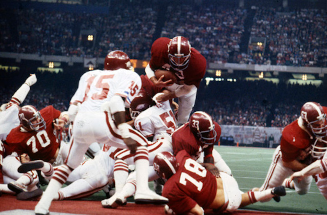
Although he only ran the ball 34 times all season, Ogilvie ran for a touchdown in the Sugar Bowl against Ohio State, a 35-6 victory, on a 1-yard run in the middle of the fourth quarter.
Even though they were 11-1, Alabama was controversially ranked second in the final rankings, behind Notre Dame.
In 1978, Alabama lost to Penn State in the Sugar Bowl but still managed an 11-1 record, good enough for first place in the nation. Ogilvie had a fantastic regular season, averaging 6.5 yards per carry and scoring eight touchdowns. In the Crimson Tide’s 14-7 triumph in New Orleans, he scored the go-ahead touchdown on an 8-yard rush in the third quarter.
After beating Arkansas 24-9 in the Sugar Bowl, Alabama finished the 1979 season 12-0 and once again was ranked #1. Ogilvie was awarded the game’s most valuable player after scoring twice on rushes of one and twenty-two yards.
In 1980, during Ogilvie’s final year as a member of the Crimson Tide, the team went on an 8-0 run and maintained that record until November, when they were eliminated from title contention after suffering defeats to Mississippi State and Notre Dame.
After a 30-2 Cotton Bowl win over Baylor, Alabama ended 10-2 and ranked #4 nationally; Ogilvie scored on a 1-yard run in the second quarter.
At Mountain Brook High School, close to Birmingham, Ogilvie was a phenomenon.
He captained his team to consecutive 1975 and 1976 state titles and was named All-America by Scholastic Coach and Adidas. He is famous for his spectacular performance in the 1976 state championship game against Murphy.
In that game, the Spartans triumphed 52-26 at Legion Field thanks to his rushing for 339 yards and four touchdowns. Ogilvie became a part of an Alabama squad that had finished 9-3 in 1976, their first losing season in six years, and had never won the SEC championship.
Tony Nathan, a fellow Birmingham high school superstar, and All-SEC fullback Johnny Davis were among the Crimson Tide’s star backs in 1977.
Ogilvie was a first-team All-SEC pick in 1979 and a second-team selection in 1980, finishing his Alabama career with 1,718 yards and 25 touchdowns in 44 games. Because Bryant believed in rotating several running backs and quarterbacks through the lineup in order to keep them fresh, Ogilvie never totaled more than 97 carries in any one season.
Ogilvie was drafted in the 12th round by the San Francisco 49ers in 1981, but was cut near the end of training camp and retired from football. He has spent many years as an executive for a concrete company in Birmingham and was inducted into the Alabama Sports Hall of Fame in 2014 and the Sugar Bowl Hall of Fame in 2017.
Lacy grew up in New Orleans, but finished high school just outside Baton Rouge in Geismar, La., after he and his family had been displaced by Hurricane Katrina. He surprised many when he signed with Alabama in the Class of 2009, which also featured five-star running back Trent Richardson.
Lacy redshirted as a true freshman, as Alabama won the first of its six national championships under Saban; and led by running back Mark Ingram, the Heisman Trophy winner. Working as the third-string running back after Ingram and Richardson in 2010, he rushed for rushed for 406 yards and six touchdowns — including 113 yards and two scores in the season-opening blowout of San Jose State, his college debut.
After that season, Ingram left for the NFL, and Richardson and Lacy split the carries in 2011. At the end of the season, Alabama won the BCS title with a 21-0 victory over LSU, and he was a major reason why. He rushed for 674 yards and seven touchdowns. After Richardson’s departure in 2012, Lacy once again took the lead. He helped Alabama win the national championship twice while serving as the backup for future great running back T.J. Yeldon. Yeldon rushed for 1,322 yards and 17 touchdowns. The 42-14 BCS title game thrashing of Notre Dame was Alabama quarterback Nick Lacy’s final game. The Fighting Irish tacklers, including Heisman winner Manti Te’o, were left in his wake as he blasted his way to 140 yards rushing on 20 carries, including a 20-yard touchdown run and an 11-yard touchdown catch. He was named the game’s most valuable player, and the Crimson Tide won their third title in four years thanks to him. After 2012, Lacy still had one more year of eligibility, but she opted to enter the NFL draft instead. When he ran for 1,178 yards and eleven touchdowns as a rookie in 2013, he was chosen in the second round and went on to win the league’s award for offensive rookie.
Before a string of ankle ailments started to limit Lacy’s play in 2013, he had another 1,000-yard season with the Packers. After five seasons in the NFL, he retired in 2017 after having thrown for 3,614 yards and 23 touchdowns with the Seahawks. Major Ogilvie and Eddie Lacy will forever be connected, even though they played on separate teams for over 30 years. Their common jersey number and their contributions to some of the best Alabama football teams ever made them inseparable.
Leave a Reply