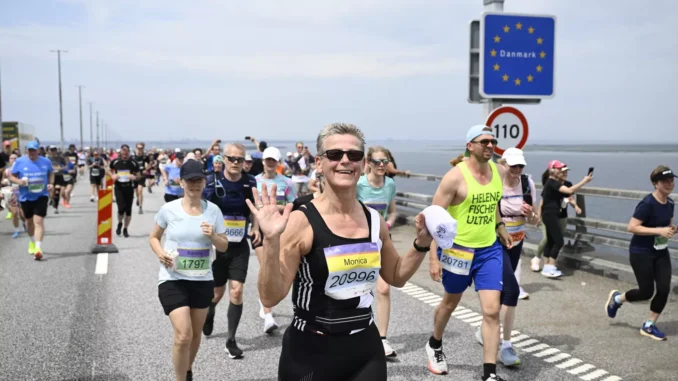
40,000 Runners Celebrate 25 Years of Europe’s Longest Bridge-Tunnel With an Unforgettable Cross-Continent Dash…Read More…
In a breathtaking celebration of engineering, endurance, and unity, over 40,000 runners from around the globe gathered this weekend to participate in a once-in-a-generation event—crossing the iconic Øresund Bridge-Tunnel on foot to mark its 25th anniversary. The colossal structure, which connects Copenhagen, Denmark, to Malmö, Sweden, served as the backdrop for an extraordinary transnational marathon that captivated hearts and headlines across Europe.
The Øresund Fixed Link, often hailed as a marvel of modern infrastructure, is Europe’s longest combined road and rail bridge-tunnel system. Spanning approximately 16 kilometers (about 10 miles), it includes a sweeping cable-stayed bridge, an artificial island, and an underwater tunnel. Since its inauguration in July 2000, the link has symbolized cross-border cooperation, economic progress, and cultural exchange between Denmark and Sweden.
But on this sunny Sunday morning, the focus wasn’t on vehicles or trains. It was on human resilience.
A Run Unlike Any Other
This monumental anniversary was commemorated with the “Øresund Jubilee Run,” a special, one-time-only marathon that gave thousands the rare opportunity to run the entire length of the bridge-tunnel. Registrations for the event opened just six months prior and sold out in record time—within 36 hours. Participants ranged from elite international athletes to local families and first-time marathoners.
Starting from the Danish capital of Copenhagen, runners dashed across the Øresund Bridge, their shadows flickering across the structure’s iconic white cables. With the early morning sun glistening off the turquoise waters of the strait below, the scene was nothing short of cinematic. The route descended onto the artificial island of Peberholm before plunging runners into the subterranean tunnel toward Malmö.
“Running through the tunnel was surreal,” said Amira Jensen, a Danish amateur runner who completed the half-marathon route. “It felt like being inside the heartbeat of Europe—moving forward, unified, unstoppable.”
A Celebration of Unity
Organizers made it clear: this event wasn’t just about fitness. It was a celebration of European unity, shared history, and a future forged through collaboration. The Øresund Region has become a vibrant economic and cultural corridor, home to over 4 million people. And the bridge-tunnel, once considered an ambitious dream, has grown into a vital artery of commerce and connection.
Swedish Prime Minister Lena Wästberg and Danish Prime Minister Mads Krüger were both present at the finish line in Malmö to greet runners and deliver speeches. Wästberg hailed the day as “a testament to the bridge’s original purpose—to bring people closer, physically and emotionally.”
Krüger echoed her sentiments: “Today, we celebrate not just a structure, but a spirit. A spirit of ambition, cooperation, and European togetherness.”
Spectacle on Both Sides
The event was not limited to the runners alone. Crowds estimated at over 150,000 gathered on both sides of the Øresund to cheer on participants, wave flags, and take part in festivities. From live bands and cultural dances to gourmet food trucks serving Nordic delicacies, the party atmosphere was palpable.
In Copenhagen, spectators gathered near the starting line at Amager to witness the grand send-off, while in Malmö, a sprawling finish line festival took over Ribersborgsstranden, complete with a fireworks display and drone light show. Kids’ races, charity walks, and even a “bridge yoga” session added to the day’s inclusive appeal.
Local businesses thrived, and hotels in both cities reported full occupancy for the weekend. “It’s the biggest weekend since Eurovision,” joked Malmö hotel manager Kristina Löfgren.
Stories That Inspire
The event brought with it not just a physical challenge, but also a cascade of deeply personal stories.
One runner, 70-year-old Erik Lundquist from Gothenburg, completed the 10K portion after having undergone heart surgery just two years ago. “Crossing the bridge was symbolic for me—like bridging the gap between sickness and health,” he shared, tearfully hugging his grandchildren at the finish line.
Another highlight was the presence of Hassan Farouk, a refugee from Syria who arrived in Malmö via the bridge nearly a decade ago. Now a Swedish citizen and running club coach, Farouk led a team of young athletes across the finish line. “The bridge gave me a new life. Today, I run for hope,” he said.
For many, the crossing was a family affair. The Petersen family from Aarhus trained together for six months, with all five members—from the youngest at 9 to the oldest at 64—finishing the 5K leg together, hand in hand.
Looking to the Future
As the sun dipped below the horizon and the last of the runners crossed into Sweden, the symbolism of the event settled into the hearts of all who witnessed it. The Øresund Fixed Link, once a feat of futuristic design, now stands as a mature, indispensable symbol of European cooperation. And on its 25th birthday, it did what it was meant to do—bring people together in a truly unforgettable way.
“We’ve shown that infrastructure is more than concrete and steel,” said event director Signe Haldorsen. “It’s about connecting lives, telling stories, and dreaming big.”
As the bridge returned to its usual routine of trains and traffic by evening, echoes of footfalls, cheers, and laughter lingered in the salt air. The Øresund Jubilee Run had come and gone—but its impact would ripple through the region for years to come.
Leave a Reply